Pediatric Endocrinologist, Neonatologist, Obesity Medicine Specialist, and The Menopause Society Certified Practitioner (MSCP) in New York City
Dr. Luisa Gonzalez Ballesteros, M.D.
Sometimes a family reaches me after the diagnosis has already been made.
They have the lab results. The imaging. The name of the condition.
And when they get home, they still cannot explain what is happening.
That has always bothered me.
A diagnosis can be correct and still leave a family without an answer they understand.
Long before EndoWell existed, I learned that medicine has to begin somewhere else.
At home in Bogotá.
Bogotá
“You examine people. Not laboratory results.”
San Agustín, Huila
“A test is only as helpful as the question you are asking it to answer.”
New York
“Each step taught me to notice something the one before it could not.”
NICU
“Sometimes calm is what makes precision possible.”
EndoWell
“Enough time to understand the question before deciding what comes next.”
Where it started
I grew up in a family where medicine, science, and curiosity were simply part of everyday life.
My mother is a pediatrician. She gave me a sentence I still hear in my head when I see a patient:
“You examine people. Not laboratory results.”
My father is a civil engineer and a chess player. He taught me something different without ever intending to teach me medicine.
“Look at what a structure is being asked to carry before deciding whether it is holding. Look several moves ahead.”
Years later, I realized how much of that had followed me into endocrinology. Growth is never just a number. A child is building a body while that body is already being asked to function.
My sister became a psychiatrist and completed a PhD in clinical epidemiology. My nephew is now a physician. My niece has just started medical school.
Medicine kept showing up in my family, but what stayed with me most was not the profession. It was the way we learned to look.
My mother taught me to see the person before the result. My father taught me to look for the forces underneath what I could see.
Neither of them was teaching me medicine. They were teaching me how to think.
Every patient deserves the same care, dedication, and effort I would want for the people I love, or for myself.
San Agustín
Early in my career in Colombia, I worked in San Agustín, Huila, caring for patients in places where access to specialists, imaging, and laboratory testing could be limited.
When the test you want is not available that afternoon, you learn quickly that careful medicine begins with what is already in front of you.
You listen. You examine. You notice what does not fit. You think before you order.
That experience never taught me that testing was unimportant. It taught me something more useful:
“A test is only as helpful as the question you are asking it to answer.”
That lesson followed me to New York.
Starting over
I came to the United States already a doctor.
But nobody here knew the doctor I had already been. So I had to prove it again.
Different country. Different language. Different system.
I took the USMLE exams and started over here.
Then, in a way, I started over again. Pediatrics led me to endocrinology. Endocrinology led me back to newborns and neonatal intensive care.
Not because I was collecting titles. Each step taught me to notice something the one before it could not.
And through all of it, one thing stayed remarkably simple: before I explain the number on the screen, I need to understand the person sitting in front of me.
Rebuilding my career did not teach me to practice that way. It showed me how much I was willing to do to keep practicing that way.
My accent stayed
Rebuilding a medical career in another country also means learning what it feels like when people hear your accent before they hear your reasoning.
My accent never disappeared. At some point, I stopped wanting it to.
It is part of where I come from, the language I grew up speaking, and the road that brought me here.
Trust does not come from sounding the same. It comes from preparation. From listening. From knowing your medicine. And from treating people with respect.
Dr. Luisa F. González Ballesteros, MD · Her method
What the NICU taught me
Neonatal intensive care taught me something else that became central to how I work.
When a room is frightened, a physician does not get to become less precise.
You still have to think. You still have to notice the small change. You still have to explain what is happening to a family whose world may have changed in minutes.
That is where I learned that calm is not separate from good medicine.
“Sometimes calm is what makes precision possible.”
What different stages of life taught me
The ages of the people I cared for kept changing.
Endocrinology taught me to recognize change that may take months or years to reveal itself.
The NICU taught me what it means when the next few minutes matter.
Obesity medicine showed me how easily biology gets mistaken for willpower.
And menopause care brought me back to a familiar problem: being told that something is normal does not necessarily help you understand why you feel different.
The question kept coming back:
What is this body doing, why is it changing now, and what do we need to understand before deciding what comes next?
That question can belong to a newborn, a child who is not growing as expected, an adolescent going through puberty, an adult seeking obesity care, or a woman in perimenopause.
Different stages of life. The same responsibility: understand what is really happening, then explain it clearly enough that someone can decide what to do with that information.
Across all of those settings, the method became the same: understand the person, read the pattern in context, use testing to answer a specific question, and explain the biology clearly enough that the next decision makes sense.
Why I created EndoWell
Over time, I started recognizing the same pattern.
A parent is told to wait and see without ever learning what, exactly, we are waiting to see. A family leaves reassured and still cannot answer the simplest version of the question: why is this happening?
That gap is why EndoWell exists.
Not because every child needs more testing. Not because every unusual pattern means disease. And not because families need faster answers.
I created EndoWell for the time that is so often missing: enough time to understand the question before deciding whether what comes next is a test, a treatment, or simply more time.
That is what concierge care means to me. Not more medicine. Not unnecessary testing. More time to think carefully, explain clearly, and make decisions with the full picture in front of us.
Sometimes waiting is exactly the right plan. You should understand what you are waiting for.
Sometimes every test comes back normal. That does not always mean the question has been answered.
My role is not to create fear or promise certainty. It is to help you understand the biology well enough to make the next decision with clarity.
That is the medicine I grew up around in Bogotá. It is the medicine I rebuilt my career to practice in New York. And it is why I created EndoWell.
Also in the office
Olivia
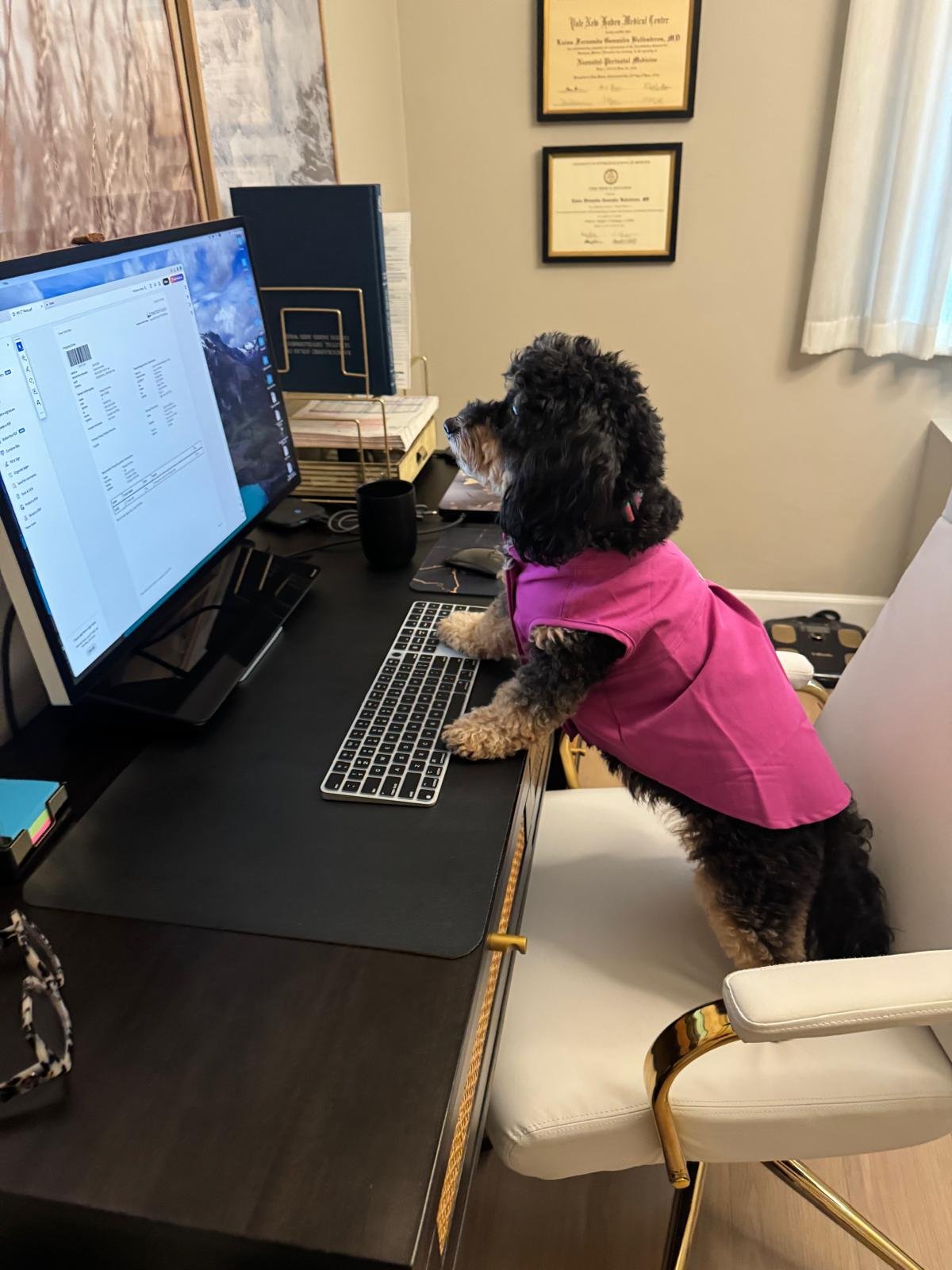
Olivia, my tiny bernedoodle and my service dog, is part of my family first.
She is my travel companion, and Colombia may be her favorite place of all. She is completely happy there, surrounded by my family, somehow knowing she belongs.
In New York, she comes to work with me and has become part of the EndoWell office team. Children often notice her before they notice me, and she brings a little extra warmth to the office just by being there. Patients who want to spend time with her are welcome to, and she keeps them company. If dogs are not your thing, or you are afraid of them, she keeps her distance and never approaches. No one ever has to say hello.
When she visits the hospital, she never goes into the NICU. She stays in the hallways, where service dogs are allowed, and she says hello to the nurses and my NICU team, who love stepping out to see her. On intense, heavy days, she has a way of making people smile.
She belongs to my family, my home, and my work. At this point, I am not sure anyone in any of those places would let me show up without her.
Training & Certification
Board Certification
Board Certified in Pediatrics, Pediatric Endocrinology, Neonatal and Perinatal Medicine, and Obesity Medicine.
The Menopause Society Certified Practitioner (MSCP).
Training
Pontificia Universidad Javeriana, Bogotá; Lincoln Hospital, affiliated with Cornell University; Children’s Hospital of Pittsburgh of UPMC; Yale New Haven Medical Center. United States Medical Licensing Examination (USMLE).
Languages
Based in New York City. Consultations in person and by telehealth, in English and Spanish.
Where she practices
EndoWell, Upper East Side, New York, NY. An independent practice.
EndoWell is an independent outpatient practice and is not affiliated with any hospital. Dr. Luisa’s NICU work is separate from EndoWell. EndoWell offers outpatient endocrine follow-up, including for newborns and infants, and does not provide inpatient or NICU care.
Phone calls and WhatsApp: +1 (917) 573-0248
Calls or messages via Klara, our patient messaging platform: +1 (646) 846-4816
When you want to understand what is happening
My practice centers on pediatric and young adult endocrinology, including growth and puberty, thyroid conditions, weight and metabolism, and PMOS (formerly PCOS). I also provide newborn endocrine follow-up and endocrine care for differences of sex development and for gender-diverse teens and young adults.
For adults, my focus is obesity medicine, perimenopause, and menopause. Across these different stages of life, my approach is the same: take the time to understand the person, put the findings in context, and explain what matters before deciding what comes next.
Whether you are coming with a first concern, or with results, a diagnosis, or a treatment plan you want to understand better, EndoWell offers in-depth consultations and second opinions in New York City, in English and Spanish, and by telehealth.